A valid Emotional Support Animal (ESA) letter is a simple, professional document—usually one page—written on the licensed mental health professional’s official letterhead. It does not need to disclose your exact diagnosis in detail (to protect your privacy), but it must contain specific elements to satisfy the Fair Housing Act (FHA) and be verifiable by landlords.
Key Required Elements
Every legitimate ESA letter should include:
Provider’s official letterhead (clinic name, address, phone, email)
Date the letter was written (must be recent—typically within the last 12 months)
Your full name as the patient
Statement that you are under the provider’s care and have a mental or emotional disability recognized by the DSM-5 (e.g., anxiety disorder, major depressive disorder, PTSD)
Explanation that the ESA is part of your treatment plan and necessary for your mental health or daily functioning
Description of how the animal helps (often brief: “provides emotional support that alleviates one or more symptoms”)
Provider’s credentials: Full name, license type/number, state of licensure, and signature
Optional but common: Type/species/breed/name of the animal (not always required, but many providers include it)
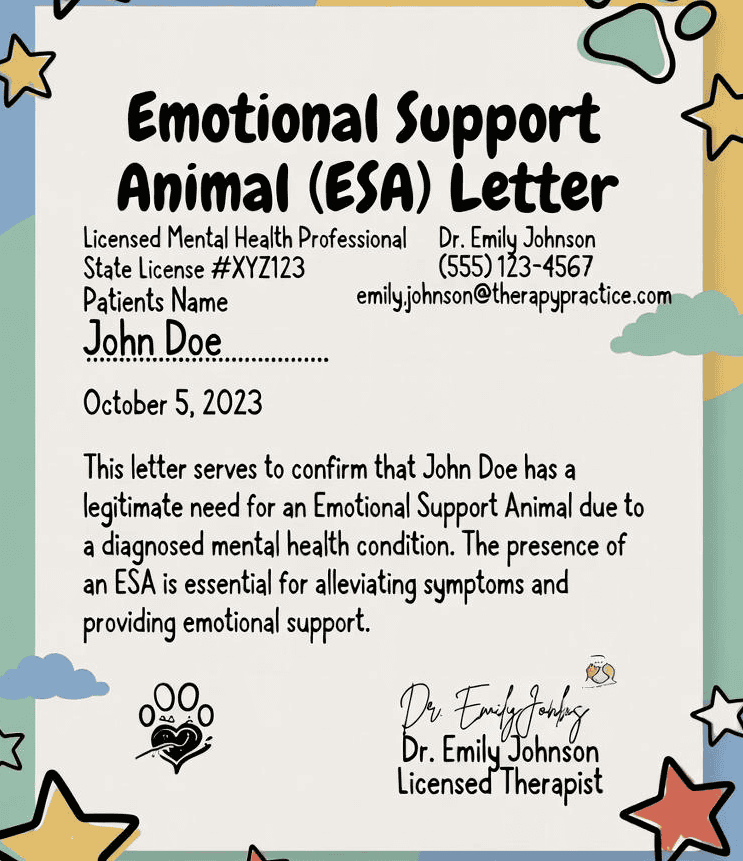
Sample ESA Letter
[Provider’s Letterhead] Dr. Jane Smith, Psy.D. Licensed Clinical Psychologist License # PSY12345, State of California 123 Main Street, Suite 100 Los Angeles, CA 90001 Phone: (555) 123-4567 | Email: drsmith@clinic.com
December 6, 2025
To Whom It May Concern:
I am a licensed clinical psychologist in the State of California (License # PSY12345) and am currently treating [Your Full Name], who is my patient.
[Your Full Name] has a mental health disability as defined by the Diagnostic and Statistical Manual of Mental Disorders (DSM-5). As part of their prescribed treatment plan, an emotional support animal is necessary to alleviate one or more identified symptoms or effects of this disability. The presence of the emotional support animal provides therapeutic emotional support that helps mitigate the symptoms of the disability.
The animal in question is a [e.g., dog/cat, breed if desired, name if desired] that lives with the patient.
This letter confirms the need for this accommodation under the Fair Housing Act. Please feel free to contact me to verify this information or if you require any additional details (while respecting patient confidentiality).
Sincerely,
[Handwritten or digital signature] Jane Smith, Psy.D. Licensed Clinical Psychologist License # PSY12345
See what a REAL letter looks like
Important Notes
Landlords can verify the license number through your state’s licensing board.
The letter does not need to specify your exact diagnosis (e.g., it can say “anxiety disorder” or simply “a mental health disability”).
It should never come from an online questionnaire-only service or include phrases like “registered emotional support animal”—those are red flags for scams.
If your letter is missing any of the key elements above (especially letterhead, license details, or a real signature), a landlord can legally reject it. Always keep the original signed copy handy.